
Start a Vanderburgh County Property Records Search
Vanderburgh County property records sit in linked systems, not one master file. The Assessor identifies parcels, current owners, sales, and assessed values. The Recorder preserves deeds and encumbrances. The Treasurer and Auditor hold tax information. GIS supplies parcel geometry. Area Plan Commission or municipal sources add permits, zoning, and subdivisions. Start with the fact you know. Then carry the parcel number and legal description from office to office.
An address is usually the fastest discovery key. An owner name can surface multiple parcels, though it demands identity checks. Once found, the parcel number is the strongest crosswalk between systems. Still, none of these substitutes for the recorded instrument. The same goes for a boundary survey or a professional title review.
- Search XSoft Engage by address, owner, or full property number.
- Save the parcel number, legal description, owner label, transfer date, township, and taxing district.
- Use the Recorder index or a focused Room 231 request to retrieve the deed and related instruments.
- Compare the tax list and GIS map against the same parcel rather than relying on a name alone.
- Order certified copies or invoke Indiana APRA for a precisely described existing record not available online.
The expanded Vanderburgh County property search guide lays out the exact search fields and the full inventory of results they return.
The Offices Behind Vanderburgh County Property Records
The core custodians share the Civic Center address but keep different evidence. Contact the office that owns the record you need. Describe a specific document or parcel rather than asking one counter to assemble a title history.
Vanderburgh County Recorder
1 NW Martin Luther King Jr. Blvd., Room 231
Evansville, IN 47708
812-435-5215
Vanderburgh County Assessor
1 NW Martin Luther King Jr. Blvd.
Evansville, IN 47708
County office route
Vanderburgh County Treasurer
1 NW Martin Luther King Jr. Blvd., Room 210
Evansville, IN 47708
812-435-5248
Search XSoft by Three Vanderburgh Keys
The assessor form accepts an owner, an address, or a property and parcel number. It also offers a map search. Owner searches go better with surname order, initials, punctuation variants, and entity suffixes tried in turn. For addresses, preserve directionals and keep situs separate from mailing addresses. Parcel searches should retain hyphens, periods, and leading zeroes exactly as displayed.
| Search key | Input | Best use |
|---|---|---|
| Owner | Person or entity string | Find parcels tied to a displayed owner name |
| Address | Street number/name/suffix | Find a known site |
| Property number | Full formatted APN | Join assessment, tax, and map records |
| Map search | Click/identify | Resolve uncertain or neighboring geography |
XSoft updates its data daily, except for the annual Property Record Card PDFs. Note the displayed date, since recent deeds and sales may still be processing into the system.
The live assessor search page shows the public entry point:
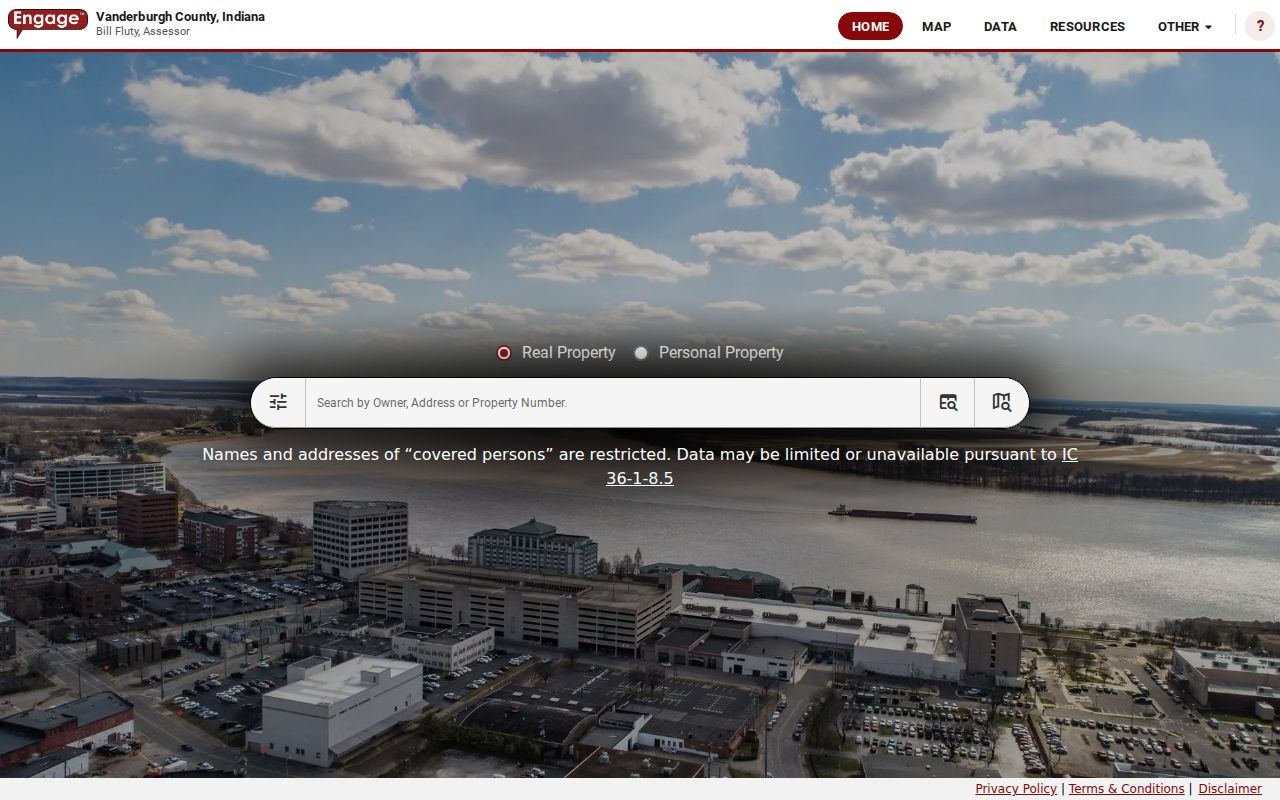
The choices on this screen begin the records trail; they never certify the underlying title.
Read a Vanderburgh Parcel Card Without Blurring Fields
Parcel 82-06-28-015-006.009-027 shows the local crosswalk in practice. Its property address is 619 RUNNYMEADE AVE. The owner mailing address reads 619 SOUTH RUNNYMEDE AVE. The legal description is REALTY PLACE L 10 in Knight Township. It sits within the EVANSVILLE CITY-KNIGHT taxing district. Its current-owner label, transfer history, sale table, value history, land, improvements, sketch, and photo each describe a different record dimension.
Parcel/APN: the administrative land identifier. Grantor/grantee: the parties conveying and receiving a recorded interest. Assessed value: the year-labeled value used in Indiana assessment administration. Plat: a recorded map of lots or subdivision geometry, distinct from a deed.
Keep the owner notation exactly as written, including abbreviations such as “T/E,” until the underlying instrument explains it. The XSoft field and update description documents this portal scope:
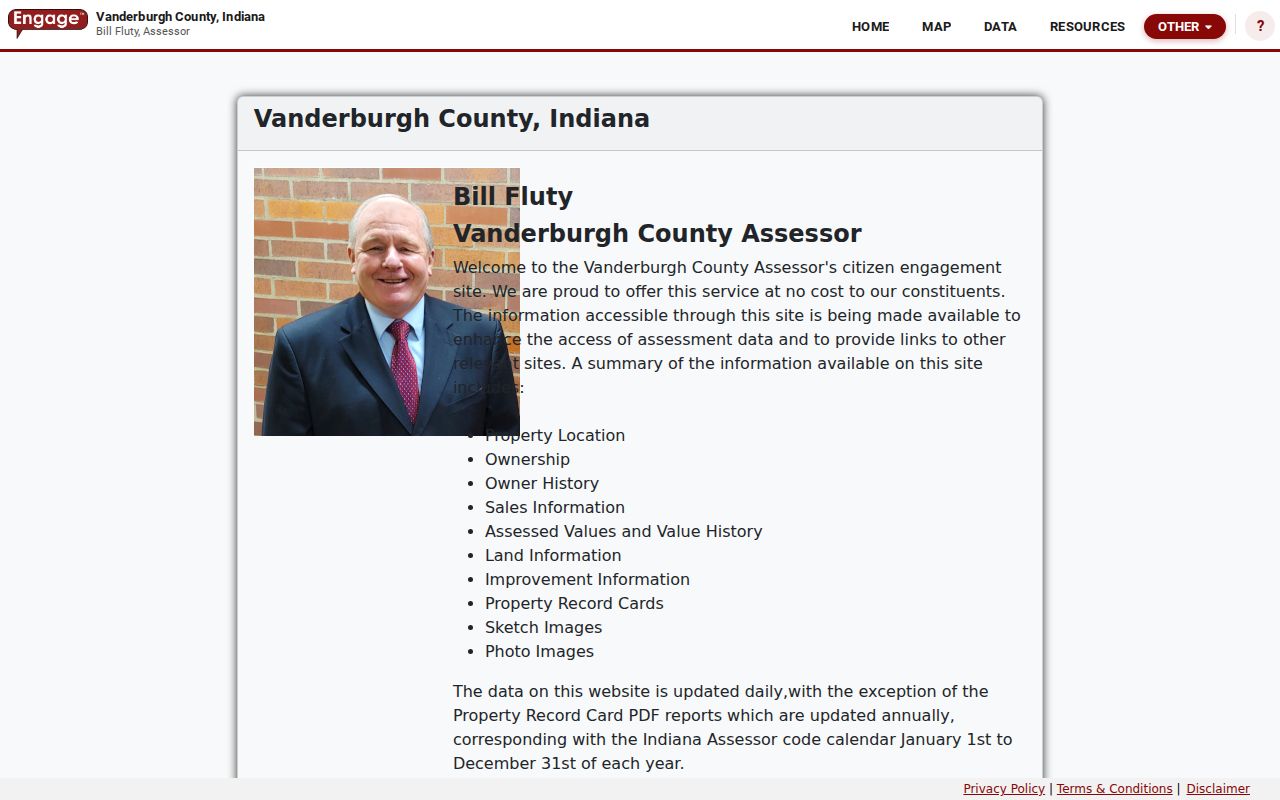
Use its source labels to distinguish portal evidence from conclusions drawn elsewhere.
Match Vanderburgh County Property Records to the Question
No single database answers ownership, value, boundaries, encumbrances, permits, and litigation. Choose the source whose custodian created the record, then reconcile the identifiers.
| Record Type | What It Documents | Kept By | Access |
|---|---|---|---|
| Deeds | Recorded conveyance and legal description | Recorder | Index, workstation, copy request |
| Mortgages and liens | Recorded encumbrance and release clues | Recorder/courts | Index and case follow-up |
| Assessment and tax | Owner field, values, deductions, bills, receipts | Assessor/Treasurer/Auditor | Public portals and office |
| Plats and parcels | Lot creation, geometry, map attributes | Recorder/APC/GIS | Subdivision search and viewer |
| Permits and zoning | Applications, inspections, petitions, land use | APC/city/town | MUNIS, archive, forms |
| Court and sale | Foreclosure, probate, partition, judgment | Clerk/Sheriff | MyCase, request, sale page |
When the umbrella search reaches a record family, turn to the focused Vanderburgh County deed records, property tax records, and parcel map resources for that material.
Vanderburgh Land Records Enter a New Fidlar Cycle
A 2026 county contract extends the Fidlar land-records lifecycle through 2031. Named capabilities include AVID, eRecording, SSN redaction, assisted indexing, public workstations, and Laredo, Tapestry, and Monarch subscriptions. That points toward continued modernization. It does not prove every module or historic year is open through one public URL.
The Recorder in Room 231 of the Civic Center remains the fallback for a direct search, workstation inspection, plain copy, or certified copy. The county publishes no confirmed online start year or current public-search URL. Confirm those details by phone at 812-435-5215.
Note: Use an index to locate an instrument, then read the deed image for parties, exhibits, prior references, and operative language.
Vanderburgh's Historic Deed Trail Reaches into Microfilm
The Indiana State Library inventory confirms grantor and grantee indexes spanning 1818 through 1901. It also covers partition records, estate indexes, and order books. Its county guide identifies Deed Book 1 and Tract Book 1 material. That material covers 1805 to 1853. These sources extend a property history after online searching ends.
Evansville street numbering adds a local twist. Numbering was adopted in 1873, and the 1874 directory used street addresses. Later directories supplied old and new references. The Willard Streets and Buildings index helps reconcile the address. So do the EVPL local history collections. After that, the legal description and the deed must verify the match.
Join the Parcel Map to Plats and Planning Records
The official assessor parcel service supports query, identify, find, export, and spatial selection. It is capped at 2,500 records. It offers useful geographic context. But map lines are not a legal survey. The county publishes no dedicated adjacent-parcel control for the public interface.
The Subdivision Search adds name, APC docket, book and page, recorded date, engineer, and a linked plat. Multi-phase records like Green River Estates show why a subdivision name and a modern parcel number can diverge. That divergence happens after a replat.
Evansville and Darmstadt Add Different Record Layers
Evansville and Darmstadt keep their property records at the county level. Yet the municipal paperwork around them looks different. Evansville leans on its APC Maps & Apps platform. The platform bundles permits, zoning cases, petitions, subdivision files, parcelization, and inspections into one ecosystem alongside its archive and MUNIS systems. Darmstadt takes a simpler approach. Its public materials focus on forms, Town Hall submissions, sewer information, meetings, and the superintendent's contact details. There is no searchable permit index.
One quirk trips people up. A Darmstadt-area address can still carry an Evansville mailing label. So a ZIP code alone proves nothing about jurisdiction. Rely on the parcel's taxing district, its APC jurisdiction, and its map position instead. County property records and municipal filings settle the question. The Evansville records page maps the city-specific route in detail. Darmstadt documents run through Town Hall and the county's own systems.
Separate Assessment, Sale Price, and Vanderburgh Tax
Indiana assesses property on a market value-in-use concept, often called true tax value. Ratio studies target a 100% assessment level. That target makes no promise. A single parcel's assessment may not match its latest sale or asking price. Sample totals shift with annual adjustments and revaluations. So they reflect administrative history rather than a countywide market trend in Vanderburgh County.
The Treasurer's tax list lets you search in several ways. Look up by district, parcel, owner name, tax year, or property address. It carries a warning. The list is not for official use. Rates break into county, township, city or town, school, library, special, and total columns. Deductions, credits, charges, and the payable year all shape the final bill alongside the assessed value. So a Vanderburgh County property search should weigh each piece.
The current assessor resources gather Form 11, Form 130, PTABOA, reassessment, and disclosure guidance in one place.
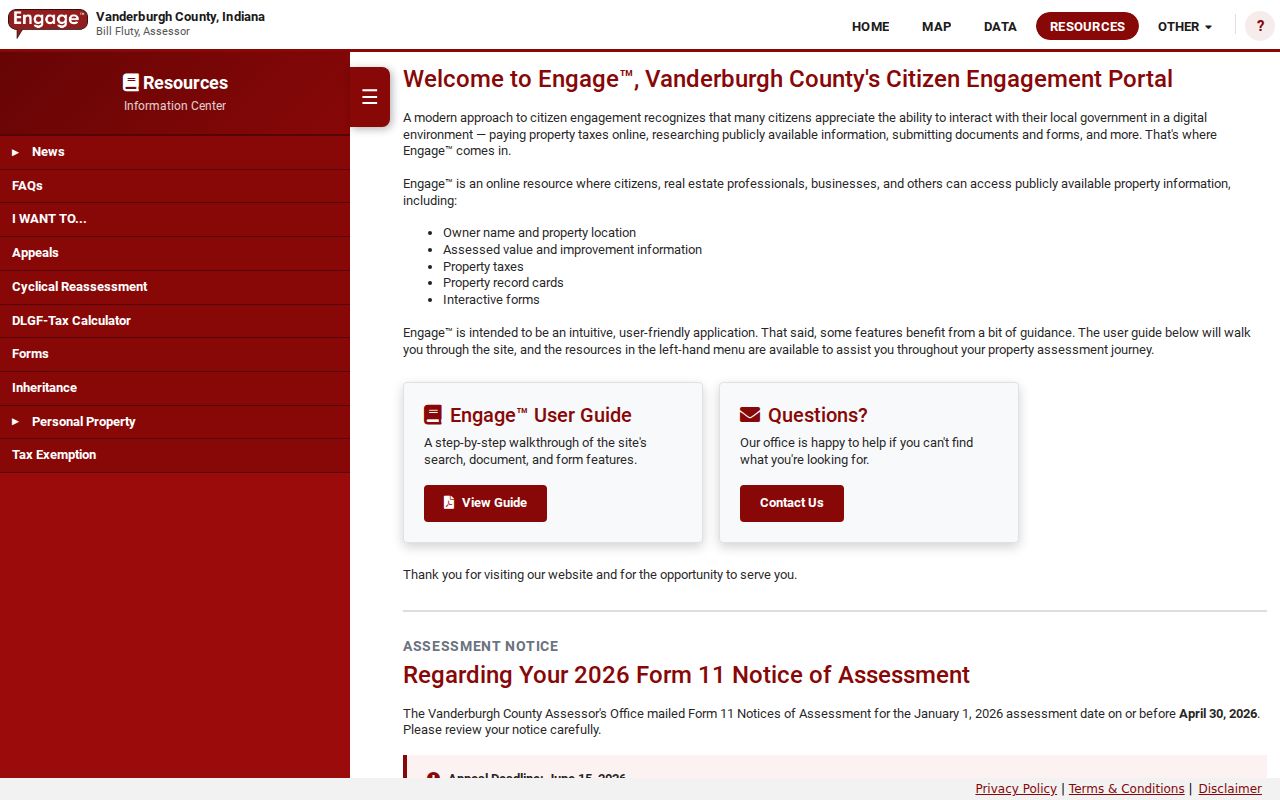
Deadlines are year-specific; use the live notice for the assessment under review.
Add Courts and Sheriff Sales When the Parcel Story Requires It
Indiana MyCase can surface non-confidential foreclosure, probate, partition, judgment, and related dockets. Search by case or by party name. Coverage is not complete, though. Not every court, year, or document appears there. So empty results call for a focused request to the Vanderburgh County Clerk rather than a conclusion that no case exists.
The Sheriff sale page lays out the local foreclosure-auction route. It tells bidders to dig into taxes, liens, title, and other charges before bidding. Keep perspective here. A sale listing or case docket never replaces the deed records and post-sale record trail that tell the parcel's real story.
What Vanderburgh County Property Records Establish
Indiana MyCase can surface non-confidential foreclosure, probate, partition, and judgment dockets. Search it by case number or party. Coverage has gaps, though. Not every court, year, or document appears there. So empty results call for a focused request to the Vanderburgh Clerk rather than a conclusion.
The Sheriff sale page walks through the local foreclosure-auction route. It urges bidders to dig into taxes, liens, title, and other charges first. A sale listing or case docket never replaces the deed. The post-sale record trail still tells the real story.
Lawful use. Vanderburgh County property records support buying and selling diligence, estate work, assessment review, boundary clues, house history, and civic transparency. Never use them to stalk, harass, or harm anyone.
Choose Free Discovery or Formal Vanderburgh Copies
| Channel | Best for | Constraint |
|---|---|---|
| Free public portal | Parcel discovery, current fields, map and tax clues | Refresh cycles and incomplete historic coverage |
| Recorder workstation or vendor access | Instrument index and images | Availability and subscription terms require confirmation |
| Plain copy | Ordinary research and reading | Not certified |
| Certified copy | Formal record use | Fee and specific request required |
| Library/archive | Historic indexes, directories, maps | Context must return to the official instrument |
Commercial compiled tools can supply a starting clue. Their provenance is often unclear, though, and stale associations make them weaker than a source-labeled county record from the Vanderburgh County recorder or assessor. For any serious file, preserve URLs, query dates, displayed dates, and identifiers such as the parcel number so the trail can be checked later.
The 2026 Vanderburgh Assessment Cycle Has Its Own Dates
Form 11 notices for the January 1, 2026 assessment went out on or before April 30, 2026. June 15, 2026 is the appeal deadline that year under IC 6-1.1-15-1.1. A prefilled Form 130 is available through the portal. Completed appeals can follow the current online, mail, or in-person instructions. Those dates describe one cycle, not a permanent annual rule. A later assessment means a later notice.
PTABOA meetings are generally held about every six weeks. Written evidence is encouraged beforehand, and testimony may be time-limited. Indiana's statewide cyclical reassessment starts July 1, 2026 for the 2026 Pay 2027 cycle and after. Roughly 25% of parcels are physically inspected each year. That inspection program and the county appeal calendar answer different questions. Cite them separately.
A value disagreement starts with the correct parcel and the assessment year. Form 11, the property record card, sales and valuation evidence, and the filing deadline matter too. It does not start with the current tax payment total alone.
Read Vanderburgh Tax Records by Year and District
The Treasurer's Tax List runs on District Number, Parcel Number, Name, Tax Year, and Property Address. A last name helps, per its instructions, and a city can ride along with the address. Too much detail, though, can choke a query. For split or combined parcels, the local guidance is simple. Search the last name across the latest two years. Results carry a "Not for Official Use" warning. Formal reliance rests with the Treasurer or Auditor.
Tax-rate results break out county, township, city or town, school, library, special, and total rates. A postal location will not select the taxing district. The parcel record does that. The published 2025 payable-2026 examples differed between Evansville City Center Township and Darmstadt Town German Township. That shows why a countywide number or a ZIP-based guess can mislead.
Access runs through online payment, a drop box, and Room 210 office service. Mail works too, at PO Box 77. Processor charges can shift, so the live checkout governs. Save the tax year, payable year, parcel, district, deductions, credits, charges, due dates, and receipt status. Don't shrink the record to one dollar amount.
Property Fraud Alerts Do Not Replace the Deed Record
Vanderburgh County's 2026 Fidlar contract adds a Property Fraud Alert module. A local report from 2024 sketched a free alert built on name and contact matching. No direct enrollment link can be confirmed right now. Ask the Recorder which channel is live before you hand over any personal details.
An alert only flags a new filing. It cannot stop one, undo one, or vouch for its meaning. The right response is a close read of the instrument itself. Check its parties, instrument number, recording date, legal description, and any prior references or corrections tied to it. If a filing looks wrong, contact the Recorder quickly. Bring in legal or title help.
Maintain a Vanderburgh Parcel Evidence Ledger
Build one crosswalk for each property you track. Log the parcel number, any Tax ID, situs address, owner mailing address, legal description, subdivision and lot, township, taxing district, and school corporation. Beside each result, note the portal URL, the query date, the displayed "as of" date, and the deed citation. Add the map method and the tax year. That small habit exposes address mismatches, replats, and reformatting quirks. It also catches update lag before it causes confusion.
Two sources will sometimes disagree. Resist the urge to overwrite one quietly. Weigh each source's custodial role and timing instead. A freshly recorded deed often lands before the assessor posts its update. An annual PRC PDF can trail daily XSoft fields, and a sale disclosure may still be moving through processing. A GIS address pins down land without proving where the owner gets mail. Hold both values until the responsible office or the recorded instrument settles the question.
The ledger pays off later, too. It keeps a Vanderburgh County property records review reproducible. Public fields, annual values, tax years, and portal dates can shift underfoot.