
Vanderburgh County Property Value Types
The XSoft parcel detail keeps the most easily confused figures separated. Read each value with its year, its event label, and its source. Total assessed value is the land amount plus the improvement amount. That sum covers one assessment entry. A sale price is different. It belongs to a dated transfer, so it may not describe the parcel's current value at all.
| Recorded figure | Meaning | Source |
|---|---|---|
| Assessed value | Indiana market value-in-use applied for assessment | County Assessor |
| Land value | The land component of the assessment | XSoft value history |
| Improvement value | The modeled value assigned to structures | XSoft value history |
| Last sale price | The consideration tied to a dated sale row | Sales disclosure and deed |
Indiana's Department of Local Government Finance sets a 100% true-tax-value target, which its assessment overview describes as market value-in-use. That standard does not mean an assessment will match every sale or asking price. Ratio studies compare assessed value against sale price across qualified evidence, parcel by parcel, to test whether the target is being hit.
A Vanderburgh County Value History
One Knight Township parcel shows why a single value should never stand alone. Its total assessed value moved from $132,400 in 2021 to $153,900 in 2022, then $215,600 in 2023, $194,300 in 2024, $200,100 in 2025, and $221,200 with the 2026 annual adjustment. Those are parcel-specific records. They are not a countywide trend, so resist reading them as one.
| Assessment year | Land | Improvements | Total |
|---|---|---|---|
| 2024 | $13,700 | $180,600 | $194,300 |
| 2025 | $19,700 | $180,400 | $200,100 |
| 2026 annual adjustment | $19,700 | $201,500 | $221,200 |
The event label matters as much as the number itself. It tells you whether an entry came from an annual adjustment, informal action, initialization, or general revaluation, which changes what the figure actually means.
Read Vanderburgh County Assessor Values
The public assessor site accepts an owner name, an address, or a property number. Open the matching parcel. Confirm the valuation year before copying the land, improvement, and total columns. The portal also carries sales, transfer, property-card, sketch, and photo material. Each plays a different evidentiary role. The official Vanderburgh XSoft portal displays all of it on the parcel page.
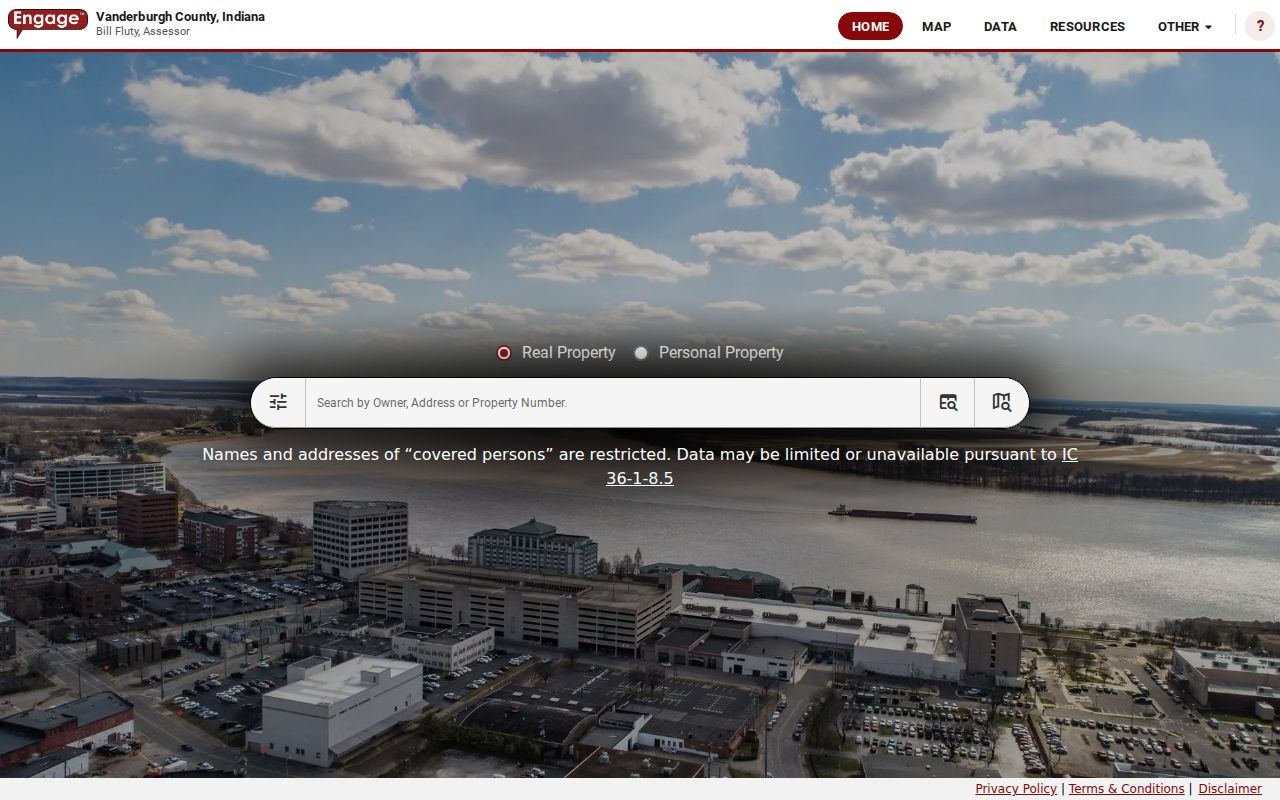
When citing a Vanderburgh County property value, use the date the result page displays. XSoft reports daily data updates, while annual property-card PDFs follow the assessor's calendar, so the two can differ.
Lookup Vanderburgh County Property Value
Start your lookup with a known address. Then save the parcel number after the first match. That number is the best control whenever the property address and owner mailing address differ, or when another county system formats an identifier differently.
- Search the street address in Vanderburgh XSoft and open the matching parcel.
- Confirm the legal description, township, and taxing district before reading values.
- Copy the assessment year, event, land, improvement, and total figures.
- Review the dated sale row and underlying disclosure or deed separately.
- True tax value
- Indiana's market value-in-use standard for the property's current use.
- Assessed value
- The value placed on the assessment roll.
- Assessment ratio
- Assessed value divided by sale price in ratio-study analysis.
Vanderburgh County Sale Price Context
One sample parcel lists a $230,000 sale dated April 4, 2024. The same record shows a 2024 assessment of $194,300. That contrast is instructive, not proof that either figure is wrong. A sale can be arm's-length, exempt, related-party, or part of a multi-parcel deal. Recent transfers may still be processing, too.
Keep dates paired. Compare a sale with the assessment in force for that period, and label the comparison as informal.
XSoft reports sales disclosures dating back to April 19, 1996 for non-exempt transfers and to late 1999 for exempt ones. The deed and its disclosure explain far more than the price row alone ever will.
Why Vanderburgh County Values Change
Annual adjustments rely on market evidence rather than waiting for a rare countywide reset. The DLGF guidance for assessments payable in 2026 describes studying 2024 sales against 2025 assessed values. It then applies a factor that may rise or fall. A factor is not a tax-rate change. The DLGF cyclical reassessment schedule begins July 1, 2026 for 2026 Pay 2027. It then runs through the next four years. About one quarter of parcels get physically inspected each year. That fieldwork may update record facts. Yet a changed value can also come from market evidence, a classification shift, or an assessor correction.
Value Is Not the Tax Bill
Deductions, credits, tax caps, local rates, referendums, and other charges all act after valuation. Two parcels with similar assessed values can still get different bills. Paying more for a property does not automatically replace its assessed value either. The billing side works differently. The Vanderburgh County property tax records guide breaks out assessment, deductions, gross tax, credits, installments, and payment status.
Challenge a Vanderburgh County Assessment
The assessor's Resources tab offers a prefilled Form 130. For the January 1, 2026 assessment, Form 11 notices were mailed by April 30, and the published appeal deadline was June 15, 2026. Those dates are year-specific. Always check them against the current notice. Evidence lands harder when it targets the record itself: parcel facts, condition, classification, comparable sales, or another claimed error. PTABOA materials encourage written evidence before the meeting, and an informal meeting can be scheduled online or through the county appeals email.
Correct Vanderburgh County Value Facts
A value may rest on parcel facts. These include class, land dimensions, structure size, condition, or effective year. One inspected record lists a 1925 year built. It also shows a 1932 effective year for the house. Those are assessment-model fields, not permit conclusions. Compare them with permits, historic maps, directories, photographs, or other direct evidence. Do this before claiming when work occurred. If a fact looks wrong, save the parcel card. Name the precise field. Tie your evidence to the relevant assessment year. The county's current Form 130 instructions also cover objective corrections. A clear field-level request beats a claim resting only on an online estimate.
Vanderburgh Improvement Value Clues
The assessor labels any structure an improvement on a Vanderburgh County parcel card. This applies whether or not it was ever renovated. The sample single-family home shows a modeled size of 1,632. A detached garage adds 324 square feet. Grade, condition, year built, and effective year round out the assessment inputs. None of these fields are engineering findings or a permit history.
Treat them as clues. They hint at the improvement component of a Vanderburgh County property value. They show why it moved one way or another. When a jump looks unexplained, set the current and prior parcel cards side by side. Then dig into the permit, sketch, classification, and review records. A higher improvement value alone never proves an addition.
Compare Vanderburgh County Sale History
In the assessor's model, an improvement is any structure, not a sign of recent work. The sample parcel lists a single-family structure at 1,632 square feet. It also lists a detached garage at 324. Grade, condition, year built, and effective year all feed the calculation. None of that is an engineering finding. It is not a permit history either.
Treat these inputs as clues to the improvement component's movement. When a jump looks unexplained, pull the current and prior parcel cards side by side. Then check the permit, sketch, classification, and review records before concluding anything. A higher improvement value alone never proves an addition.
Date Vanderburgh County Property Values
The sample sales list shows $129,000 in 2013, $124,000 in 2009, $75,000 in 2008, and older prices behind those. The sequence tells you when transactions happened. It is not a price index. Condition, parcel composition, transaction type, related parties, and market timing can all differ from sale to sale.
The 2024 row links to a sales disclosure. Open it, and the deed, whenever a transaction matters. XSoft dates disclosures from April 19, 1996 for non-exempt property and from late 1999 for exempt property, while recent sales may still be processing.
Read Vanderburgh Land Values
XSoft updates its data daily. The annual Property Record Card PDFs follow the assessor calendar. So a live value panel and a downloaded card can reflect different effective moments. Neither page is wrong. Note the query date, the assessment year, and the event label whenever you capture a figure.
For any published comparison, cite the official portal and the exact parcel result. Keep the parcel number and legal description intact. That lets another reader reproduce the match. A screenshot stripped of its source date ages fast during appeal and annual-adjustment season.
Limits of Vanderburgh County Property Values
An assessment in Vanderburgh County is a mass-appraisal for public administration. It is not a promise of sale price. It does not state rebuild cost. It does not fix a boundary. And it does not stand in for a parcel-specific appraisal. When the assessor says “improvement,” the word means a structure in the model. It does not prove the construction was new.
Value is not price. A Vanderburgh County assessed value is not a forecast of the next sale. Use a qualified appraisal when a current opinion of value is required.