
Inside Vanderburgh County Property Tax Records
Vanderburgh County's tax record works like stacked layers. The Assessor supplies parcel identity and the assessed value. The Treasurer's tax list and statement add district, installments, charges, penalties, and payment context, while the Auditor brings deductions, rates, receipts, judgments, statistics, and calculation tools.
| Tax field | What it explains | Custodian |
|---|---|---|
| Assessed value | Land, improvements, total, and year | Assessor |
| Deductions and credits | Reductions between gross tax and final liability | Auditor |
| Installments | Spring and fall due dates and amounts | Treasurer |
| Charges and penalties | Other assessment, delinquency, and late-payment lines | Treasurer |
| Taxing district | County, township, municipal, school, library, and special rates | Treasurer |
Neither the assessed value nor the final bill equals a sale price. Deductions, credits, local rates, referendums, and separate charges all shape the numbers that appear on a statement.
Search Vanderburgh County Tax List Fields
The official Vanderburgh Treasurer Tax List accepts a District #, Parcel #, or Name. You can also enter a Tax Year or Property Address. A last name works when an address fails. Entering too much detail can also knock a valid match out of the results. For split or combined parcels, the county's own instructions recommend a last-name search. Try the last two years.
| Search box | Practical use |
|---|---|
| Parcel # | Retain punctuation and leading zeroes. |
| Name | Try the last name before adding terms. |
| Tax Year | Select the year tied to the bill. |
| Property Address | Include the city, then simplify if needed. |
The list displays “Not for Official Use!” Contact the Treasurer for an official balance.
A Vanderburgh County Tax Statement
A tax statement covers tax year 2025 payable 2026. It shows why a bare "taxes are X" answer falls short. The statement names a Center Township parcel, a 5.4809 rate, and two installments of $1,121.73. Each installment breaks down as $1,118.23 tax plus a $3.50 Other Assessment. That structure is the detail worth checking.
Read every line. State the tax year, payable year, installment, deductions, credits, charges, and status with any amount.
Read the statement next to its separate tax information record. That record breaks out assessment, deduction, gross tax, credit, and taxes as distinct values, so every component stays visible.
Lookup a Vanderburgh County Tax Bill
Start with the address. Match the parcel number, legal description, township, and tax year next. County systems format identifiers differently, so the address and legal description act as the strongest cross-checks.
- Search by address, parcel, name, district, or tax year.
- Match the identity and open the applicable payable year.
- Separate assessment, deductions, gross tax, credits, and installments.
- Check current status and request a payoff when needed.
- Assessment year
- The year for which the parcel is valued.
- Payable year
- The year in which tax based on that value comes due.
- Taxing district
- The combined set of local rate components.
- Other Assessment
- A statement line separate from tax.
Vanderburgh County Tax District Rates
The official Treasurer rate table splits each rate into separate columns. These cover County, Township, City/Town, School, Library, Special, and Total Rate.
For tax year 2025 payable 2026, the table listed a total of 3.433800 for Evansville City Center Township. It showed 2.725600 for Darmstadt Town German Township.
Those two figures each describe a single year and a single district. Always confirm the tax record itself. A postal city name alone does not establish the taxing district.
Pay Vanderburgh County Property Tax
The Treasurer offers online payment through Forte. Other routes include phone payment at 1-877-690-3729 with jurisdiction code 2436, mail to PO Box 77, Evansville, IN 47701, a Civic Center drop box, and counter service in Room 210. Observed processor terms showed a 2.15% card fee. The e-check minimum ran $0.65. Fees can change, so verify at checkout and call 812-435-5248 about receipts, returned payments, delinquency, or an official balance.
Vanderburgh County's 2026 Reassessment
Indiana's cyclical reassessment begins July 1, 2026 for 2026 Pay 2027. It then runs through the next four years. The cycle touches every parcel in turn. Inspectors visit about 25% of parcels each year. Annual adjustments also draw on market evidence. So reassessment, trending, and rate changes are not the same event. The county's official XSoft Resources page carries the year-specific notices and appeal material.
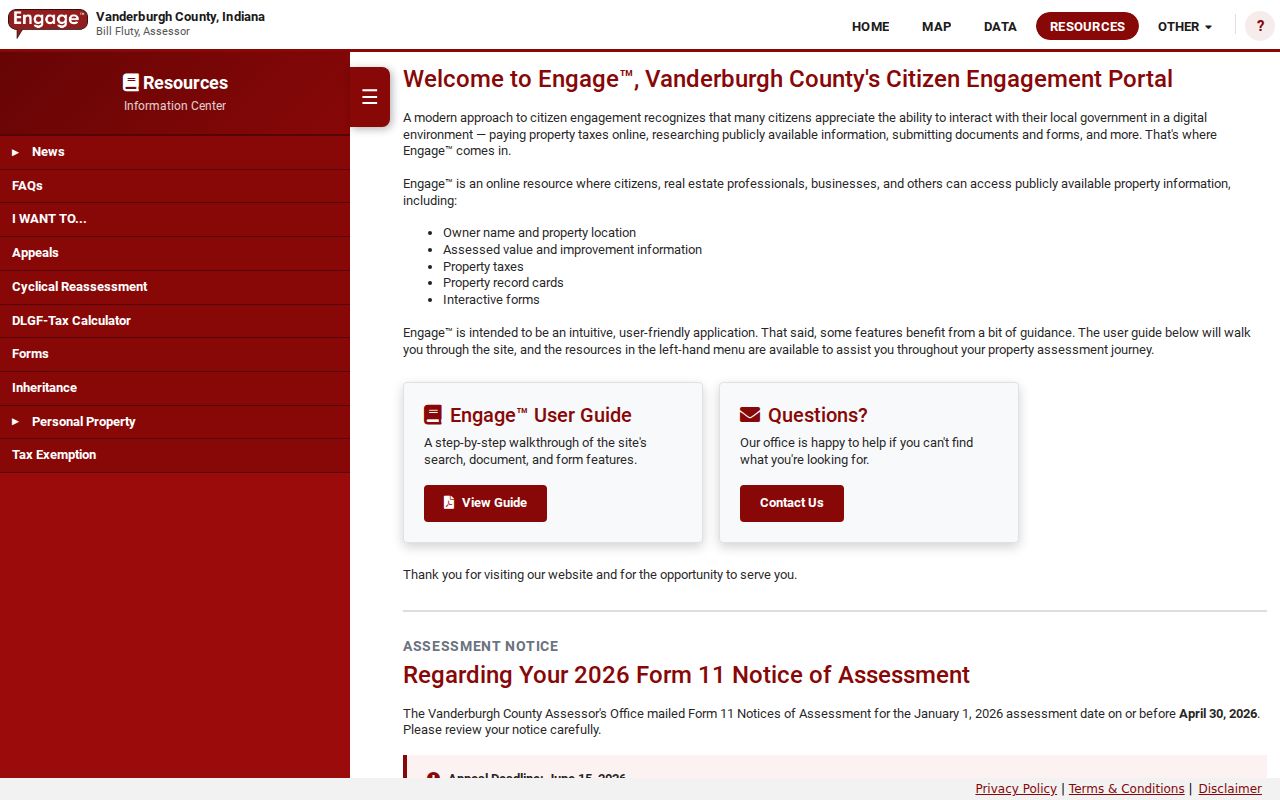
The XSoft Resources page anchors the published cycle. Check its Form 11 and Form 130 dates yearly. The Assessor's value history also keeps event labels separating annual adjustments, informal changes, initialization, and general revaluation entries.
Vanderburgh County Assessment Versus Bill
The sample assessor parcel shows the value side. Its 2026 annual adjustment splits $19,700 of land from $201,500 of improvements. The total is $221,200. That is one parcel in Knight Township, not a county average. The Treasurer statement sample sits on a different parcel in Center Township. Blending the two would build a false property profile.
Indiana's standard is true tax value, meaning market value-in-use for the property's current use. A bill can still move without the assessed total changing. Deductions, credits, circuit-breaker limits, referendums, local rates, and separate charges all play a part. Each one acts inside the fiscal record. Anyone comparing years should copy each component. Dividing an amount due by an unrelated sale price proves nothing.
Check Vanderburgh County Tax Status
A current account marks each installment paid, open, or delinquent. Statements can add prior tax, penalties, fees, and later charges. The 2025 Pay 2026 sample showed none of those. Another parcel or a later date can differ.
Tax-sale and sheriff-sale records are separate streams. When a parcel appears in a tax-sale notice, record the notice date, parcel and legal description, stated amount, redemption terms, later-charge warning, and deed timing. Then confirm the live Treasurer status. A notice promises nothing. It ensures neither availability, cleared liens, nor immediate possession for a bidder.
Vanderburgh County Tax Record Help
Taxes get paid at the Treasurer's office. You'll find it in Room 210 of the Civic Center Complex, 1 NW Martin Luther King Jr. Boulevard in Evansville. Bring the parcel number and property address. Add the owner, tax year, and statement line. A narrow request helps the staff separate a payment issue from an assessment or deduction problem.
Form 11 and value questions go to the Assessor. Payment, installment, and balance questions stay with the Treasurer. Auditor tools add rate, deduction, receipt, judgment, and charge context. Deeds and liens come from the Recorder, so the fiscal offices cannot certify ownership just because a name appears on a tax account.
Vanderburgh County Tax Year Labels
Indiana pairs each assessment year with a later payable year. Keep both labels whenever you quote a value or a bill. One statement may read tax year 2025, payable 2026. Its spring and fall installments both fall in 2026. Drop one label. A correct amount can look like it belongs to the wrong cycle.
Due dates need their year too. The example lists May 11 and November 10, 2026. It shows a 5% penalty after the due date when no delinquent amount applies. Prior delinquency gets separate 10% treatment as stated on the bill. Dates after June 10 and December 10 get the same treatment. Those terms describe one statement, not a permanent calendar. Check the current bill before paying or advising anyone else.
Match Vanderburgh Tax Parcels
Parcel formats vary across county systems. The assessor example reads `82-06-28-015-006.009-027`, while a Treasurer record may punctuate the same number differently. Never strip zeros or force one form into another. A district number is a billing jurisdiction and may not be a parcel identifier.
Match on several fields instead. The property address, owner name, legal description, township, taxing district, and tax year together pin down the right account. If a parcel was split or combined, search the last name for the prior two years, as the Treasurer suggests. That older account can hold the missing bill.
Prepare Vanderburgh Appeal Evidence
Name the assessment you are challenging. State the facts you claim are wrong. Useful evidence includes a property record card, dated photographs, measurements, comparable qualified sales, repair evidence, and documents correcting classification or parcel data. A recent purchase price is relevant context. It does not automatically set the assessment.
County materials say an informal meeting may be scheduled online or through appeals@vanderburghgov.org. PTABOA meetings run about every six weeks and are open to the public. Testimony may be capped at five minutes. Submit organized written material early, keep proof of delivery, and hold on to the Form 130 version that applies to the assessment year.
Appeal Vanderburgh County Property Assessments
Form 11 notices went out by April 30. For the January 1, 2026 assessment, the Form 130 deadline is June 15, 2026, and filing may go by mail, delivery, or online. XSoft offers a prefilled Form 130.
Appeal dates change. June 15 applies to the published 2026 cycle. Read the current Form 11 before relying on an earlier deadline.
PTABOA has three voting members. The Assessor serves as secretary and a non-voting member. Written evidence is encouraged before the meeting. Don't wait until the hearing to gather records. Save the Form 11, the parcel card, the value-history entry, and proof that Form 130 was filed on time. An objective-field dispute, rather than a valuation judgment, calls for the matching part of Form 130 under current county instructions. Older references to Form 133 can be stale because the usual objective-correction route changed in 2017. A year-specific county source beats an archived appeal summary.